Go to Part Two
©2021,
David E. Robinson: At the Gates of Yerushalayim Ministries
Lessons
from the Wilderness, Volume 42
Halakah, Part 1… the Tallit Gadol…
The Great Shawl [i] [ii] [iii] [iv]

Luke
8:42b-48
…As Jesus went, the people spressed
around him. 43 And there was a woman twho
had had a discharge of blood for twelve years, and though she had spent all her
uliving on physicians,6 she could not be healed
by anyone. 44 She
came up behind him and touched vthe
fringe of
his garment, and wimmediately
her discharge of blood ceased. 45 And
Jesus said, “Who was it that touched me?” When
all denied it, Peter7
said, “Master, the crowds surround you and are pressing in on you!” 46 But Jesus said, “Someone touched me, for I perceive that xpower has gone out from me.” 47 And when the woman
saw that she was not hidden, she came trembling, and falling down before him
declared in the presence of all the people why she had touched him, and how she
had been immediately healed. 48 And
he said to her, “Daughter, yyour faith has made you well; ygo in peace.” [v]
Today I will begin a new series on Halakah,
or the way to walk. The topic I have chosen to start with is a simple
explanation of the Tallit and Tzitzit (and for those who read me
regularly you know it will be anything but simple, lol). Before we go
there, let us take another look at this incident, only this time in Mark’s
Gospel:
Mark 5:24-34 (NET® Bible)
5:24 Jesus35
went with him, and a large crowd followed and pressed around him.
5:25 Now36 a woman was there who had been suffering
from a hemorrhage37 for twelve years.38
5:26 She had endured
a great deal under the care of many doctors and had spent all that she had. Yet
instead of getting better, she grew worse. 5:27 When
she heard about Jesus, she came up behind him in the crowd and touched his
cloak,39 5:28 for
she kept saying,40 “If only I touch his clothes, I will be
healed.”41 5:29 At
once the bleeding stopped,42 and she felt in her body that she was
healed of her disease. 5:30 Jesus
knew at once that power had gone out from him. He turned around in the crowd
and said, “Who touched my clothes?” 5:31 His disciples said
to him, “You see the crowd pressing against you and you say, ‘Who touched me?’”
5:32 But43
he looked around to see who had done it. 5:33 Then
the woman, with fear and trembling, knowing what had happened to her, came, and
fell down before him and told him the whole truth. 5:34 He said to her, “Daughter,
your faith has made you well.44 Go
in peace and be healed of your disease.” [vi]
(Jesus/Yeshua’s) words in red for clarity-Author)
As noted in the endnotes,
this incident can also be found in Matthew 9:18-26, but we will use these two
for the basis of discussion. First, a bit of explanation of how Yeshua might
have been dressed, this from the Lexham Bible Dictionary:
… “Outer Garments. The most common outer
garment of this time was the cloak (ἱμάτιον, himation).
Cloaks were generally rectangular in shape—which distinguished them from the
toga and other kinds of Roman outer garments—and were available in different
sizes. Cloaks could be worn draped around the body and/or over the shoulder
without being fastened (Cleland et al., Greek
and Roman Dress, 92). The Gospels describe people taking off their cloaks
when working in the field (Mark 13:16), approaching Jesus (Mark 10:50), and
welcoming Jesus into Jerusalem (Mark 11:7–8). Some cloaks had fringes, as seen
in Jesus’ cloak (κράσπεδον, kraspedon;
Matt 9:20) and those of Pharisees (κράσπεδον, kraspedon;
and φυλακτήριον, phylaktērion; Matt 23:5) …”
[vii]
So, let us surmise that in Jesus’s time, He wore as an outer garment a
cloak. Being rectangular in shape would have given Him four corners onto which
were tied the Tzitziot (plural form). I must also conjecture that the cloak did
not extend to the ground, as that would have made His Tzitziot drag on the
ground, something He would not do, for it would show disrespect to the
commandment to wear the Tzitzit:
Bəmīḏbar (בְּמִדְבַּר, literally "In the desert
[of]") – 15:37-41
[Numbers 15:37-41] Tanakh]
37The Lord
said to Moses as follows:
38Speak to
the Israelite people and instruct them to make for themselves fringes on the
corners of their garments throughout the ages; let them attach a cord of blue
to the fringe at each corner. 39That shall be your fringe; look at
it and recall all the commandments of the Lord and observe them, so that you do
not follow your heart and eyes in your lustful urge. 40Thus you
shall be reminded to observe all My commandments and to be holy to your God.
41I the Lord
am your God, who brought you out of the land of Egypt to be your God: I, the
Lord your God.[viii]
Again,
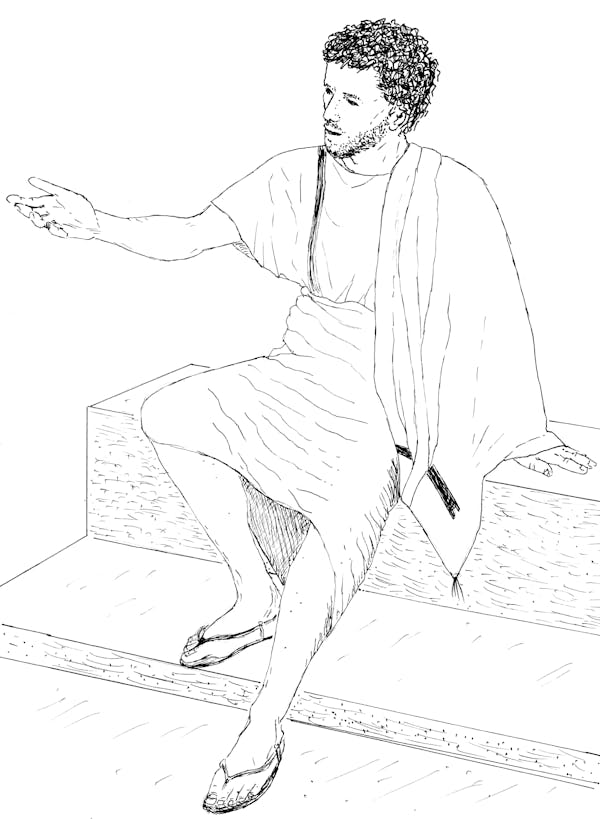
when we surmise what Yeshua wore, it is not the images we see in art or in
movies. He might have dressed like this:
Figure 1:
https://images.theconversation.com/files/204866/original/file-20180205-19937-1kc98g3.jpg?ixlib=rb-1.1.0&q=45&auto=format&w=600&h=819&fit=crop&dpr=1
The short tunic he most likely wore was in keeping with his
background: a carpenter used to manual labor. The tunic was short, knee length
or slightly below to allow for movement in this type of work. His cloak might
have been wore as shone, or it could have fitted over his head and tied with a
sash about the waist. What He would not have dressed like is this:
For
one, his outer garment would not have been long. How do we know this?
Mark 12:38-40(NASB)
38 aIn
His teaching He was saying: “Beware of the scribes who
like to walk around in long robes [στολή; Transliteration: Stole or Phonetic: stol-ay'][ix], and like brespectful
greetings in the marketplaces, 39 and chief
seats in the synagogues and places of honor at banquets, 40 awho devour widows’ houses, and for
appearance’s sake offer long prayers; these will receive greater condemnation.”[x]
In the time of Yeshua/Jesus[xi],
it was the wealthy men who would don long robes on special occasions, or to
show off their status in public. Thus, the scorn Yeshua spoke of in Mark
12:38-40 tends us to believe He did not wear the stolai.[xii]
( [xiii])
On another note, we can also deduce that Yeshua did not have
long hair (see 1 Corinthians 11:14), but He did most likely wear a beard (Leviticus
19:27, 21:5). We are so used to seeing the Byzantine depictions of our Lord,
that we do not even try to see him as He really was; a Semitic Jew. Maybe He
resembled one of these:
Figure 2 ©Rendition by Akiane Kramarik
or this:

Figure 3
©Rendition by Bas Uterwijk
Now, what I know is this: He looks like no image we have
ever seen. Isaiah stated it thus:
Isaiah 53:1-2
(NASB95)
1 aWho has believed our message? And to whom
has the arm of the Lord been revealed?
2 For He grew up before Him like a atender 1shoot, and like a root out of parched ground; He
has bno stately
form or majesty that we should look upon Him, nor appearance that we should
2be attracted to Him. [xiv]
3 He was adespised and forsaken of men, a man of 1sorrows and bacquainted with 2grief; And like one from whom men hide their face.
He was cdespised,
and we did not desteem Him. [xv]
What a glorious day it will be to
stand before Him face to face. I say this with all humility, that I am not
worthy enough to gaze upon His face, yet I long for that day. What I want to
show is that He is not white, with long blonde hair and blue eyes. He would be
of olive-toned skin, or perhaps he is as depicted here:
 Figure 4
©"Father forgive them" by Alix Beaujour
Figure 4
©"Father forgive them" by Alix Beaujour
Was Yeshua black? Do any of us
really know? Would it make a difference to you? He is the King of kings and
the Lord of lords… We divide each other, through class, race, gender, and ethnicity: we want Him to look like us or we want
Him to fit our lifestyle and habits. You can see Him drawn by
every race, every creed, and nationality. Yet how many of us want to be
like Him? How many of us do what He says, live like He directed? He did
no more than His Father told Him to do. He said no more than His Father
instructed Him to do. Yes, you might say, what does this have to do with the
Tallit!?!
Nothing.
Everything.[xvi]
The Law
of God, or better, the Torah, is what our Master lived by. It was how He was
raised, how His family lived, and what He taught. So, I ask the question again:
how many of us want to be like Him?
I want
to lovingly voice a caution here. When Gentiles (meaning non-Jews) come to the
root of their faith, the Torah and the Tanakh, they desire to emulate their
Jewish/Israelite brethren. They adopt the kippah[xvii],
the Tallit[xviii],
the Tzitzit[xix].
They may or may not eat kosher (which depends on how far they want to take
their faith), they might even adopt the Tefillin[xx].
But do they do this out of love and respect for HaShem, and do so with the
fullness of their heart, or is it because they think it is, well, for lack of a
better word, “stylish”?
There
is a lesson here. We, as Gentile believers in Messiah Yeshua and the Torah, must remember we
are not Jewish. In this age of those that scream about cultural appropriation, any
follower that comes into Messianic Judaism should recognize that there are
protocols involved in adopting the Jewish ways. I am talking about respect and
consideration for the faith that delivered once for all – and for the covenant
people it was given to. Remember, the Scriptures were not written to us, but
they were written for us. We must be cognizant of this basic fact. It is the
Hebraic perspective of life that must first be adopted before we can even begin
to think about the wearing of the Tzitziyot or the
Tallit or anything else.
It has
been said, imitation is the sincerest form of flattery, but imitation for the
sake of imitation is only an insult to those who have practiced their faith for
thousands of years. The Hebrew faith, what we call Judaism, has gone through
cycles of change, adapting, and surviving in times of trouble and terrors; for
that reason alone, we must approach it with a humbleness and consideration that
speaks to honor the sacrifices that the Jewish people have had to withstand
over the past, and which occur even to this present age. We cannot don the
items that represent a faith if we do it causally, or carelessly: this only
adds insult to injury. For an observant Jew, even his own Talmud and Mishnah say
a Gentile should not be taught the Torah as seen from this article from the
Jerusalem Post:
“…In contemporary society, non-Jews learn Jewish texts in
many forums, including university classrooms and Internet sites.
Sometimes this study occurs even without Jewish instruction,
such as in South Korea, where schoolchildren study a selection of Talmudic
stories. This phenomenon is the latest development in the historical discussion
regarding the propriety of teaching Torah to non-Jews.
The Torah states, “Moses has commanded us the Torah, an
inheritance for the community of Jacob” (Deuteronomy 33:4). Deeming this
inheritance, the exclusive property of Jews, the sages prohibited gentiles from
learning Torah and Jews from teaching it to them. A strident prohibition was
also expressed in the Zohar.
While the Talmud elsewhere mentions that non-Jews were
taught Torah, some of those cases were clearly under the coercive pressure of
the dominant rulers.
Scholars have offered various rationales for the Talmudic
prohibition, which broadly impacted its scope. Based on Talmudic exegesis, some
scholars understood any non-Jewish study as a betrayal of the unique bond
between Jews and God or a misappropriation of national treasure, with a few
even contending that this included potential converts who had not yet joined
the nation. Some went so far as to ban teaching the Hebrew alphabet, although other
sources indicated that this was a pragmatic step to prevent polemical abuses by
hostile anti-Semites. In a similarly polemical vein, one medieval source
suggested that gentiles can learn the Prophets and Hagiography (Writings)
because its prophecies prove that God has not abandoned the Jewish people.
Yet most scholars limited the prohibition in one form of
another. The Talmud itself contends that gentiles may learn material necessary
to properly observe the seven Noahide laws. In this spirit, Rabbi David Tzvi
Hoffman argued that one may teach non-Jews the narrative portions of the Torah
which will inspire belief in the grandeur of God. Beyond that, rabbis Naftali
Berlin and Tzvi Hirsch Chajes contended that the prohibition only applies to
aspects of the Oral Law but not to the written Scriptures.
Alternatively, Rabbi Samuel Eidels argued that the
prohibition only included the “reasons and secrets” of the Torah but not the
basic texts or laws, with Rabbi Eliyahu Mizrahi further contending that the
prohibition could be waived if one cannot extract oneself from a situation
without discussing that information…”[xxi]
So, if
the study of the Torah itself by Gentiles seems problematic, think about how
watching Gentiles wear the Tallit, Tzitziyot, or the Tefillin affect the
faithful Jew. One writer puts it this way:
“When I was studying biblical counseling at a conservative
Baptist seminary five years ago, a student invited me to a Passover Seder on
campus. I was reluctant to respond because the student was a Messianic Judaism major,
and the Seder was being hosted by his department. My relationship with this
student was already fraught because we had major theological disagreements —
often in the middle of lecture — about whether or not the Messianic movement
was a branch of Judaism, or a denomination of Christianity. His position was
the former: mine the latter.
Because he already purchased a ticket in my name, I agreed
to attend the Seder and tried to keep an open mind about it. But the truth was,
despite embracing the Christian faith in college, a sizeable part of me felt
defensive about my Jewish traditions. I knew that an event that treated the
bowl of salt water as the tears Christ shed on the cross, rather than the tears
shed by the Jews when they were slaves in Egypt, wasn’t really a Seder in any
traditional sense. If it were called a “Last Supper Commemoration Ceremony,” or
“Good Friday Service,” I would have felt differently — but words mean things,
and a Seder this was not.
This is just one of the ways that many Christian groups
think they are honoring Judaism and the Jewish roots of the Christian faith.
But as someone with one foot in both worlds — a Christian with Jewish identity
— honor is not what it feels like. Rather, it comes off as exploitative.
The Christian faith has plenty going for it by its own
merit: a personal God who loved his creation so much that he came down to earth
in the flesh, offered himself up as a sacrifice for our sins, and promised
redemption from a cruel world. There’s no need to denigrate Judaism by
manipulating its rituals or presenting caricatures of what they look like in
practice…”[xxii]
Now, to
be fair, there are differing opinions in the Jewish community, both positive
and negative. For the Messianic believer though, it is always proper to put
our best face forward and do nothing that would bring dishonor to God, Yeshua,
and our Jewish brethren by acting in an inappropriate way.
I have
just touched on the basics of Halakah, our walk. Next post, I will speak to
these subjects again, but to keep the post brief, let us stop here.
May HaShem,
blessed forever is His name, richly bless you all, my beloved.
Amein
Endnotes:
[i]NOTICE OF INTELLECTUAL PROPERTY
RIGHTS: Unless
otherwise cited, all material found on this blogsite (original text, opinions,
conclusions, and other material not related to cited sources remains the
collected intellectual property of the author of this site, David E. Robinson,
Elder, Teacher, and are owned and controlled by myself and are protected by
copyright and trademark laws and various other intellectual property rights and
unfair competition laws of the United States, foreign jurisdictions, and
international conventions. Any errors found within, rest solely upon me; please
do not blame the Father for my mistakes. I am teachable and correctable, not
infallible. 😊
[ii] FAIR USE DISCLAIMER: This
blog site may contain content that is not authorized for use by its owner. All
such material will be cited back to its original source. According to Section
107 of the Copyright Act: “…the fair use of a copyrighted work […] for purposes
such as criticism, comment, news reporting, teaching (including multiple copies
for classroom use), scholarship, or research, is not an infringement of
copyright…” I have made and will continue to make every effort to stay within
all ethical and moral guidelines in the use of material presented here, and the
use of these materials is solely intended for educational purposes only, and
all efforts to obtain or sustain fair use of non-owned material will be made.
[iii] Author’s note: This site is
for education only and is not affiliated with any institution, organization, or
religious group. It is the sole production of its editor. Use of information
from Jewish-themed websites (or any other source material) should not be
construed as these sites endorsing or confirming any thesis introduced by the
author of this epistle. I present the information from their respective sites for
instructional purposes only and/or to aid in the readers understanding of the
subjects discussed.
[iv] Author’s note:
Throughout this study I may be using the NET Bible® and the NET Notes®: within
the notes you will see symbols like this: (א B Ψ 892* 2427 sys). These are
abbreviations used by the NET Bible® for identifying the principal manuscript
evidence that they (authors and translators of the NET Bible®) used in
translating the New Testament. Please go to https://bible.org/netbible/ and see
their section labeled “NET Bible Principals of Translation” for a more complete
explanation on these symbols and other items pertinent to the way the NET Bible
uses them.
6
Some manuscripts omit and though she had
spent all her living on physicians
v
Matt. 14:36; 23:5; [Num. 15:38, 39; Deut. 22:12]
7
Some manuscripts add and those who were
with him
x
ch. 5:17; 6:19; [Acts 10:38]
36
tn Grk “And.” Here καί (kai)
has been translated as “now” to indicate the transition to a new topic.
37
tn Grk “a flow of blood.”
38
sn This story of the woman who had been suffering from hemorrhages for
twelve years is recounted in the middle of the story about Jairus’
daughter. Mark’s account (as is often the case) is longer and more detailed
than the parallel accounts in Matt 9:18–26 and Luke 8:40–56. Mark’s fuller
account may be intended to show that the healing of the woman was an
anticipation of the healing of the little girl.
39
tn Grk “garment,” but here ἱμάτιον (himation)
denotes the outer garment in particular.
40
tn The imperfect verb is here taken
iteratively, for the context suggests that the woman was trying to muster up
the courage to touch Jesus’ cloak.
41
tn Grk “saved.”
sn
In this pericope the author uses a term for being healed (Grk “saved”) that
would have spiritual significance to his readers. It may be a double entendre
(cf. parallel in Matt 9:21 which uses the same term), since elsewhere he uses
verbs that simply mean “heal“: If only the reader would “touch” Jesus, he too
would be “saved.”
42
tn Grk “the flow of her blood dried up.”
sn
The woman was most likely suffering from a vaginal hemorrhage, in which case
her bleeding would make her ritually
unclean.
43
tn Grk “And.” Here καί (kai)
has been translated as “but” to indicate the contrast present in this context.
[vii] Janghoon Park, “Clothing,”
ed. John D. Barry et al., The Lexham
Bible Dictionary (Bellingham, WA: Lexham Press, 2016).
a Mark 12:38–40: Matt 23:1–7; Luke 20:45–47
[ix] an
equipment in clothes, clothing
a.
spec. a loose outer garment for men extending to the
feet, worn by kings, priests, and persons of rank. Definition from the BTSCTVM Concordance, E-sword®
electronic edition, ©2000-2021 Rick Myers
b
Matt 23:7; Luke 11:43
[xi] From this point on, I will refer to
Jesus with His Hebraic name “Yeshua”. In biblical passages, if it says Jesus in
the quote, it is because I won’t alter the text; but His name is Yeshua (Y'shua
(ישוע with vowel pointing יֵשׁוּעַ
– Yēšūaʿ in Hebrew; alternative form of the name יְהוֹשֻׁעַ
(Yəhōšūaʿ – Joshua))
[xiv] New American Standard Bible : 1995 update.
1995. LaHabra, CA: The Lockman Foundation.
a Ps 22:6; Is 49:7; Luke 18:31–33
[xv] New American Standard Bible : 1995 update.
1995. LaHabra, CA: The Lockman Foundation.
[xvi] From the movie “The Kingdom
of Heaven”, a 2005 historical epic directed by
Ridley Scott. At the end of the movie, Balian (Orlando Bloom) asks what the
city of Jerusalem is worth. Saladin’s (Ghassan Massoud) response is
"Nothing" turns around and walks towards his camp, then turns back
around to face Balian and says "Everything" with a smile on his face,
and then returns to his camp.
[xvii] “…A kippah (skullcap
or yarmulke) is a small hat or head covering. In traditional
Jewish communities only, men wear kippot (the plural of
kippah) and they are worn at all times (except when sleeping and bathing)… It
is considered a sign of reverence for God.” (See What Is A Kippah? | My
Jewish Learning ).
[xviii] “…A tallit (also called tallit
gadol or by its Yiddish name, tallis) is a Jewish prayer shawl worn by men and
women during morning prayer services and on the Sabbath and on holidays. They
are used to prepare the mind and heart for prayer and inspire elation and
reverence for God…” (See the article Symbolism of
the Tallit (jewishgiftplace.com) )
[xx] “…Tefillin is one of
the most important Mitzvot (precepts) of the Torah. It
has been observed and treasured for thousands of years, right down to the present
day. The Torah mentions it more than once, but most explicitly
in Deut. 6:8 "And
you shall bind them for a sign upon your hand, and they shall be for ornaments
between your eyes." Tefillin consists of two small
leather boxes attached to leather straps. The two boxes each contain four
sections of the Torah inscribed on parchment…” (See Tefillin
and Its Significance - Tefillin (chabad.org) )